
AI Related Scope 1,2,3 Emissions
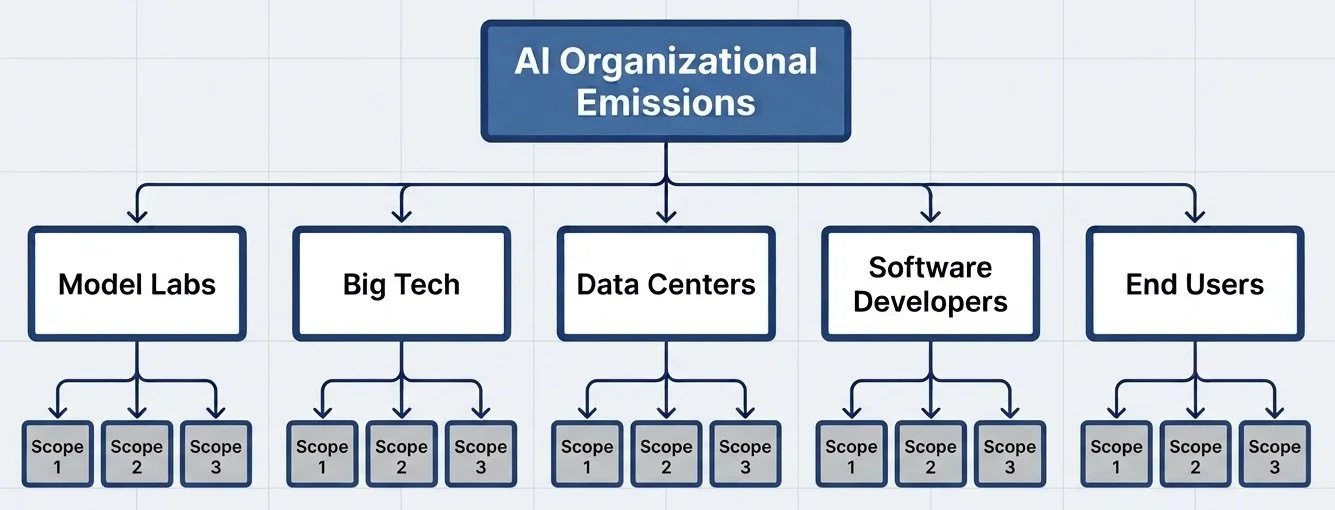
The energy use & emissions associated with AI vary by organization types, whether they are model labs, tech giants, data centers, software developers or end users. In this article, we highlight the GHG emission Scopes that are relevant to these various organizations in the AI pipeline. All of them have the standard Scope 1 (direct emissions related to fuel use etc) and Scope 2 (indirect emissions of purchased electricity) associated with offices, however, companies that own data centers have more substantial emissions in those categories. Our special focus in this article is on the Scope 3 emission categories which are significant to each organization type that deals with AI.
These are meant to be general guidelines and only pertain to the AI portion of a business. In that vein, we have omitted categories 6 (business travel) & 7 (employee commuting) as they are universally applicable. For a comprehensive inventory, that includes all non-AI activities as well, each organization’s overall emissions will need to factor in its unique business model and operations.
AI Model Developers
Anthropic, OpenAI, Google, Meta, Microsoft are some well known companies that are developing prominent AI models. Of these, some, like OpenAI and Anthropic model labs, are dedicated to model development. Others, like the tech giants Google, Meta, Amazon and Microsoft, sell other products and services as well. They also own some data centers to host their software products, including their AI models, in addition to leasing data centers from independent cloud operators. These distinctions between model labs and the big tech companies is reflected in the following categorization of their emissions.
Model Labs
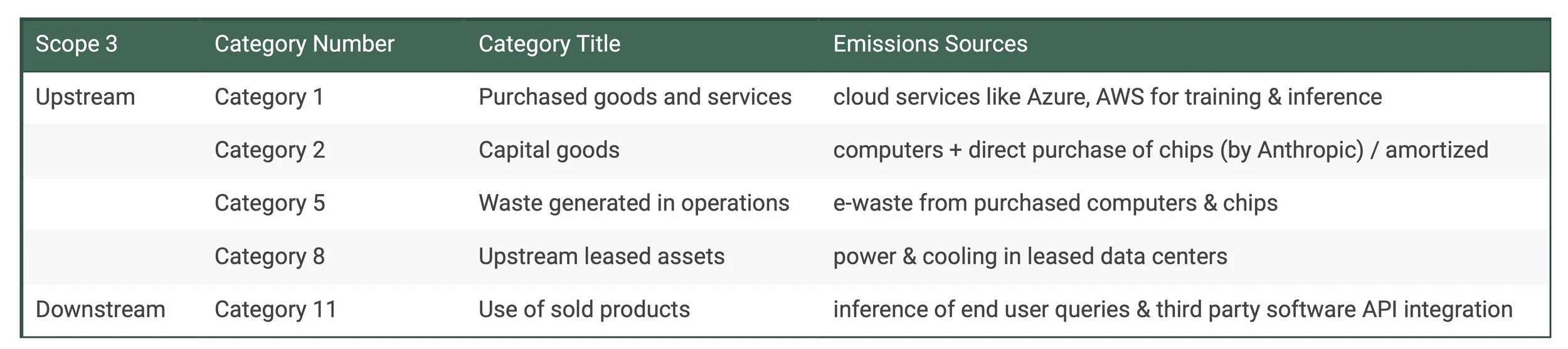
Anthropic & OpenAI are prominent examples of model labs. These companies develop the AI models but rely on external data centers to host and run these models, be it for training or inference. As of now, Anthropic and OpenAI do not own any data centers of their own. The following gives an idea of the complex ecosystem that has to be factored in for emissions accounting purposes.
OpenAI largely relies on Microsoft Azure for its model hosting. Its business is also financed in large part by the behemoth GPU producer NVIDIA. The three companies have a highly co-dependent and enmeshed relationship when it comes to AI — OpenAI makes the models that run on NVIDIA chips and are hosted on Microsoft Azure servers. (Microsoft also licenses OpenAI’s LLMs for its Copilot AI.)
Anthropic, on the other hand, has a more diversified dependency on Amazon’s AWS (that use their in house Trainium chips) and Google Cloud (powered by their own tensor processing units or TPUs) but also leases through Microsoft Azure (NVIDIA GPUs)
Here’s what the AI emissions profile of a model lab would entail:
Scope 1, 2: Typical emissions related to fuel use in company vehicles and electricity used in office spaces.
Scope 3: The AI relevant emissions categories are encapsulated in the table below.
Big Tech
Tech companies like Microsoft, Google, Meta, Amazon all have their in house AI models which they host on their own data centers as well as on leased locations. As mentioned above, they also provide hosting services on their data centers. (Google Cloud, Amazon AWS and Microsoft Azure are major cloud providers for all kinds of software.)
Data centers require large amounts of electric power to run the servers and to keep them cool so they don’t overheat. (Their water usage is also tremendous.) The hyperscalars especially are housed in very large warehouses with significant embedded emissions of building material. As AI demand grows, cloud facilities are scaling to accommodate thousands of server racks of multiple servers. AI servers carry a complex labyrinth of electronics prominently dotted with the power hungry accelerator chips (GPUs, CPUs, etc) and memory components.
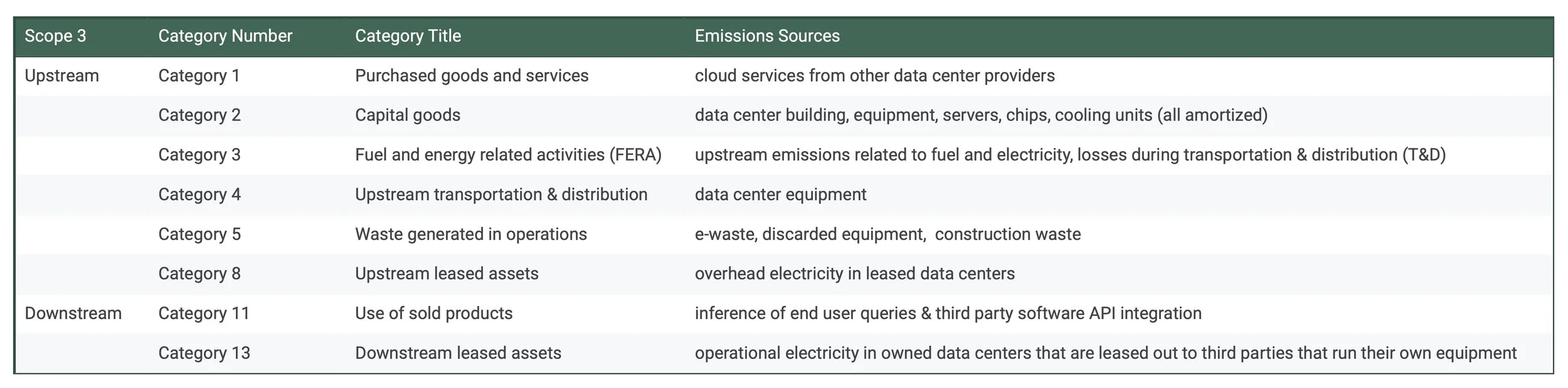
Keeping all this in perspective, the AI related emissions of such tech companies will generally encompass the following scopes:
Scope 1: (In addition to standard fuel emissions from company vehicles)
Any fuel used in owned data centers
Fuel used in DRUPS (diesel rotary uninterrupted power supply) backup generators
Fugitive emissions from coolants used in data centers
Scope 2: (In addition to standard emissions from electricity used in offices)
Electricity used to power and cool the owned data centers
For leased data centers, if there is operational control (eg racks in leased space) then electricity use will be counted here
Scope 3:
AI Data Centers
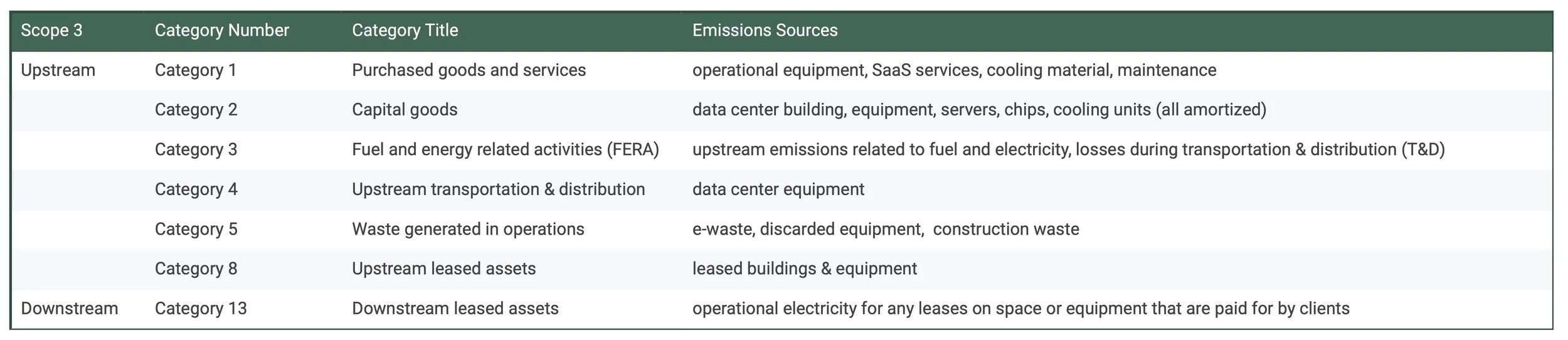
The global demand for AI has resulted in a data center gold rush of sorts with many real estate and independent operators setting up new infrastructure. Unlike the Big Tech companies that use some of their owned data center capacity to host their own products, these independent cloud operators lease out their space entirely. This somewhat changes the inventory of carbon accounting although most of the AI related categories are the same as the Big Tech’s list in the previous section.
Scope 1: (Significant)
Fuel
Refrigerant leaks
Scope 2: (Significant)
Electricity purchased for power and cooling
Scope 3:
AI Software Developers (API Integration)
When new LLM models are released, they are either put to use as Chatbots for inference by end users or they are incorporated into third party software via their API. There are very many examples of software developer companies incorporating AI into their products. We outline below the typical emissions profile of such companies related to their AI product development.
Scope 1, 2: Typical emissions related to fuel use in company vehicles and electricity used in office spaces.
Scope 3:

AI End User Organization
AI end users form the largest segment in the AI organizational pipeline since AI use is virtually ubiquitous. However, the question as to whether AI has contributed significantly to an end user organization’s overall emissions profile does not have a straightforward answer. Some sectors have adopted AI quite heavily compared to others. Even then the percentage increase due to their AI related emissions will depend on their roles. For example, finance and healthcare are both heavy users of AI but it creates a bigger impact in finance because information technology forms a bigger slice of its overall operations. That does not imply that AI related emissions can be ignored in sectors like healthcare, it just means it will be part of a bigger emissions portfolio.
From an emissions accounting point of view, for most end users the biggest impact will be only in a single Scope 3 category.
Scope 1, 2: Typical emissions related to fuel use in company vehicles and electricity used in office spaces.
Scope 3:
Upstream emissions significant to AI
Category 1: Purchased goods & services - energy used in LLM inference
Conclusions
When it comes to AI related emissions, one size does not fit all. In this article, we have delineated the emissions profile according to where an organization fits into the AI pipeline. Model labs, Big Tech companies, data center operators, third party software developers and end users all have to allocate emissions differently. For some, the AI related emissions are largely concentrated in Scope 3 whereas for others it is split across all Scopes.
There are various ways to measure these emissions: token based, spend based, and direct measurements. We will address these in another article.